Procedure · Número de Identidad de Extranjero (NIE)
How to get a NIE number in Spain
The NIE is a personal identification number for foreigners dealing with Spain. Many people are given one automatically and never need to apply; those who do apply pay €9.84, not the €12 usually quoted.
Checked at source ·
- Official fee
- €9.84
- Official name
- Número de Identidad de Extranjero (NIE)
- Forms
- EX-15 · 790-012
- Steps
- 6
- Documents required
- 5
Source: Ministerio del Interior — Tasas — Extranjería. Checked .
Who needs one
Anyone who deals with Spain in a way that requires identifying them: buying property, working, studying, opening a bank account, inheriting, or being party to an administrative procedure under immigration law.
Step by step
Check whether you actually have to apply
The Directorate-General of the Police assigns a NIE automatically — de oficio — to anyone for whom a procedure is opened to obtain a document allowing them to stay in Spain, and to anyone who has an administrative file opened under immigration law. If that is you, no application is needed and paying a fee would be pointless. For visas, automatic assignment applies only to visas allowing more than 90 days in any 180-day period. Automatic assignment does not apply if your connection to Spain is economic, professional or social — buying a house, taking a job, starting a company — and in that case you do have to apply.
Where: No action needed if assigned automatically
Confirm you meet the two conditions for applying
Applying on the grounds of economic, professional, social or other interests is allowed only if you are not in Spain irregularly, and only if you state the reasons you are asking for the number. Both are conditions in the rule itself, not office preferences, and the second is why a bare application with no explanation gets rejected.
Decide where to apply — and note that from abroad it is different
Inside Spain you apply in person, or through a legal representative with sufficient power of attorney, at an Immigration Office (Oficina de Extranjería) or a National Police station (Comisaría de Policía). From outside Spain the application goes to the Comisaría General de Extranjería y Fronteras through the Spanish consular office covering where you live — not to a police station, and not by post to Spain. Choosing the wrong route is the most common way this procedure stalls.
Where: Oficina de Extranjería or Comisaría de Policía in Spain; Spanish consulate abroad
Complete form EX-15 in duplicate
The official application is form EX-15, submitted in duplicate, filled in and signed by the foreign national. Two copies means two signed originals, not one original and a photocopy.
Pay the fee on form 790, code 012
The fee for assigning a NIE at the applicant's own request is €9.84, paid using tax form 790 with code 012. Note that this is not the €12 figure most English-language guides give — €12 is the fee for an EU registration certificate, which is a different procedure.
Submit, and count five days
The procedure must be resolved within a maximum of five days from the application entering the register of the body competent to process it, and the decision must be notified within that same period. If that period passes with no answer, the application is deemed rejected rather than approved. Spanish administrative law calls this negative silence, and it matters: waiting quietly for a letter that will never come is how people lose months.
What the official screens look like
The hardest part of most Spanish procedures is not knowing what the rule says, it is finding the right option on a government website that assumes you already know its vocabulary. These are the actual screens, with the choice to make on each one.
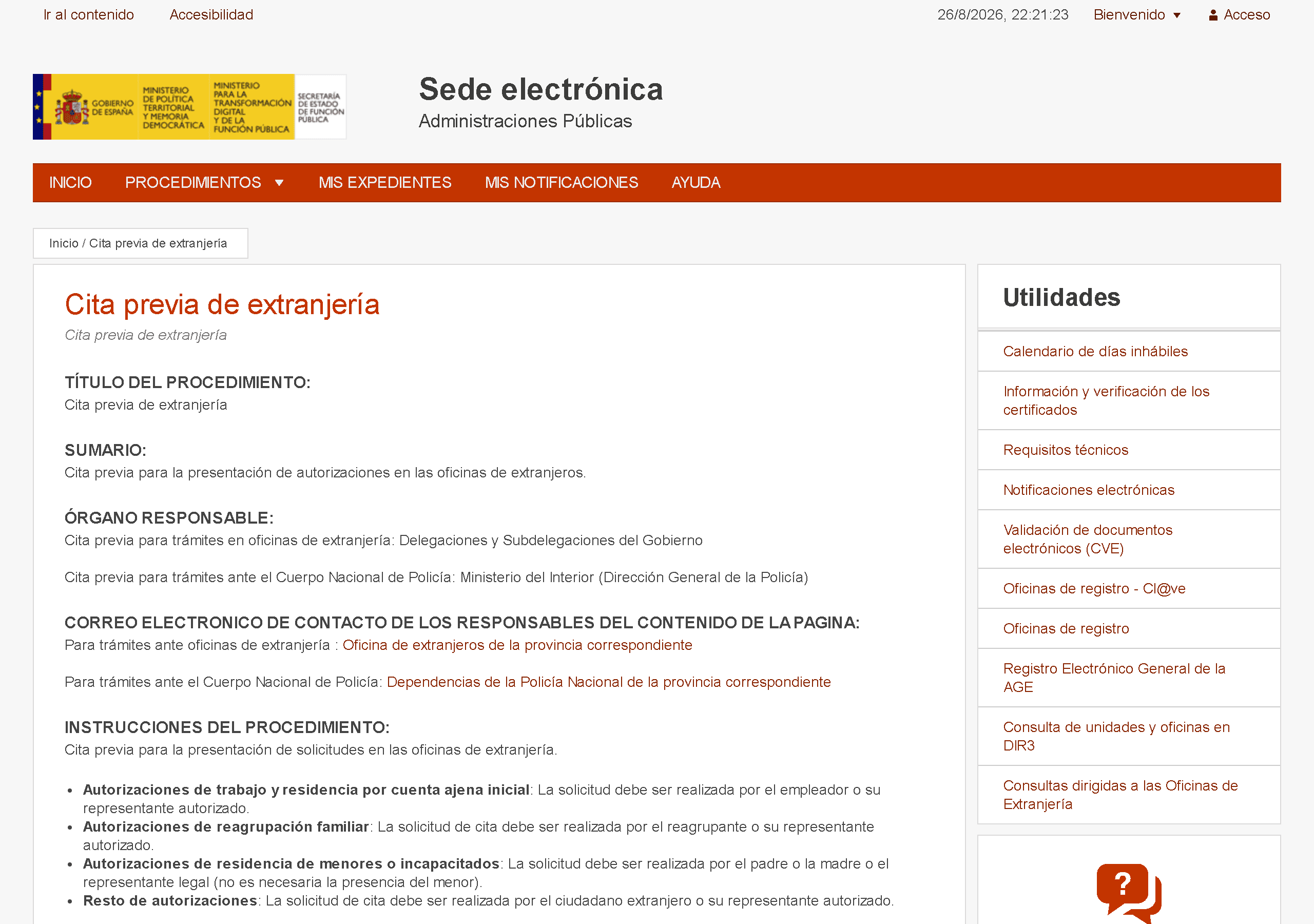
- Appointments at immigration offices are run by the Government Delegations and Sub-delegations. This is the route for authorisations — work, residence, family reunification.
- Appointments with the National Police are a separate system under the Ministry of the Interior. This is the route for identity documents: the NIE and the TIE. Two systems, two booking paths — picking the wrong one is the single most common mistake.
- Contact for immigration-office procedures goes to the immigration office of your own province, not to a national address.
- Contact for National Police procedures goes to the police premises of your province. Which building that is depends on the procedure — our province pages list them.
- Read this list before booking: for an initial work and residence permit the appointment must be requested by the employer, and for family reunification by the sponsor — not by the person who needs the permit.
Documents you need
Application form EX-15, in duplicate
EX-15The official form, completed and signed by the foreign national. Two signed copies are required.
Proof of payment of fee 790/012
790-012€9.84 for assignment of a NIE at the applicant's request.
Passport or equivalent, original and copy
A complete passport, identity document, travel document or valid registration certificate. Both the original and a copy are required — the original is returned.
Statement of the reasons for the application
A written explanation of the economic, professional, social or other interests that justify the request. This is a formal requirement, not a courtesy.
Power of attorney, if applying through a representative
The representative must show sufficient power of attorney which states expressly that they are authorised to submit this application. A general authorisation is not enough.
Common questions
How much does a NIE cost in Spain?
€9.84 when you apply for one yourself, paid on tax form 790, code 012. Most English-language guides say €12, which is the fee for an EU registration certificate — a different procedure with a different form. The figure comes from the Ministry of the Interior's published fee table.
Do I have to apply for a NIE, or is one given to me?
It depends on why you need it. The police assign a NIE automatically to people who are going through a procedure for a document allowing them to stay in Spain, and to anyone with an administrative file opened under immigration law. You have to apply yourself if your connection to Spain is economic, professional or social — for example buying property or starting work.
How long does a NIE take?
The rule sets a maximum of five days from the application entering the register of the competent body, and the decision must be notified within that period. In practice the wait people actually experience is for the appointment, not the decision, and appointment availability differs sharply between provinces.
What happens if nobody answers within five days?
The application is deemed rejected, not approved. Spanish administrative law calls this negative silence. It means you should follow up rather than wait, because no further notification is coming.
Can I get a NIE from outside Spain?
Yes. Applications from outside Spain go to the Comisaría General de Extranjería y Fronteras through the Spanish consular office covering your place of residence. You cannot apply from abroad directly to a police station in Spain.
Can someone else apply for my NIE?
Yes, through a legal representative, but the representative must hold power of attorney that expressly states they are authorised to submit this specific application. A general power of attorney is not sufficient.
Which office, in your province
Not every police station handles every procedure, and the assignment differs from province to province — in Alicante the residence card is issued at one address and the NIE at another. Pick your province to see the offices that actually do this one, with addresses and phone numbers.
- A Coruña
- Álava
- Albacete
- Alicante
- Almería
- Asturias
- Ávila
- Badajoz
- Balearic Islands
- Barcelona
- Burgos
- Cáceres
- Cádiz
- Castellón
- Ceuta
- Ciudad Real
- Córdoba
- Cuenca
- Girona
- Granada
- Guadalajara
- Gipuzkoa
- Huelva
- Huesca
- Jaén
- La Rioja
- Las Palmas
- León
- Lleida
- Lugo
- Madrid
- Málaga
- Melilla
- Murcia
- Navarre
- Ourense
- Palencia
- Pontevedra
- Salamanca
- Santa Cruz de Tenerife
- Segovia
- Seville
- Soria
- Tarragona
- Teruel
- Toledo
- Valencia
- Valladolid
- Bizkaia
- Zamora
- Zaragoza
Sources
Every fact on this page comes from one of these. We do not cite other guides, because a copy gives us no way to notice when the original changes.
- Documentación de las personas extranjeras — Número de Identidad de Extranjero (NIE)Ministerio del Interior
- Tasas — ExtranjeríaMinisterio del Interior
- Cita previa de extranjeríaMinisterio de Política Territorial y Función Pública
This is information, not advice
Your own case depends on your nationality, your current status and your history with the administration — none of which a web page can see. Confirm anything that matters with the responsible authority or a qualified professional before you act on it.