Procedure · Tarjeta de Identidad de Extranjero (TIE)
TIE: the Spanish foreigner identity card
The card issued to non-EU nationals authorised to stay in Spain more than six months. You must apply in person within one month, and it proves your legal status — not your identity, which is why you still have to carry your passport.
Checked at source ·
- Official fee
- From €16.08
- Official name
- Tarjeta de Identidad de Extranjero (TIE)
- Forms
- 790-012
- Steps
- 7
- Documents required
- 6
Source: Ministerio del Interior — Tasas — Extranjería. Checked .
Who needs one
Anyone issued a visa or authorisation to stay in Spain for more than six months, anyone renewing such an authorisation, anyone whose situation or card details change, and anyone whose card has been stolen, lost, destroyed or damaged.
Step by step
Confirm your authorisation has actually been granted
A TIE cannot be issued on its own. Two things must already exist: a government resolution granting the corresponding authorisation, or recognition of your right to stay in Spain, and payment of the legally established fee. Applying before the resolution exists wastes the appointment.
Apply within one month — and note what starts the clock
You have the right and the duty to obtain the card, and must apply personally within one month. The month runs from your entry into Spain, or from when the authorisation is granted or takes effect, depending on the case and on registration with the relevant Social Security scheme. It does not run from when your appointment happens, which is why booking early matters more than it looks.
If you entered without a passport stamp, act within 72 hours
The initial application needs a passport or travel document bearing the entry stamp or control mark applied at the border. If you have no stamp — which is normal when arriving overland from another Schengen country — you need a valid passport plus a declaration of entry, and that declaration must be made personally at any police station or immigration office within a maximum of 72 hours of entering Spain. Miss that window and the initial application becomes considerably harder.
Where: Any Comisaría de Policía or Oficina de Extranjeros, within 72 hours of entry
Book an appointment and go in person
The application is submitted personally at the Documentation Unit of the National Police, located inside the Oficina de Extranjeros or Comisaría de Policía of the province where you have your address, with an appointment booked through the electronic office of the public administration. Minors must be accompanied by their legal representative, properly accredited and carrying original valid identity documents, or by a person they have empowered.
Where: Unidad de Documentación de la Policía Nacional, at the immigration office or police station of your province
Bring originals — they are returned
Original documents are presented and given back once they have been checked, so there is no need to leave your passport behind. Bring the official application form, completed and signed, as an original rather than a copy.
Carry it, and carry your passport too
Holders are obliged to carry the card and show it when asked by the authorities. But the card certifies your administrative situation, not who you are: under article 13.1 of Organic Law 4/2015 you prove your identity with the document issued by your own country. In practice that means carrying both, and it is the single most common misunderstanding about this card.
Report changes within one month
Changes of nationality and of habitual address, and changes in family or any other circumstances affecting the details on the card, must be reported personally within one month to the police station or the police services at the immigration office where you live. If you are formally required to report something, the deadline shortens to fifteen days from that requirement. Losing the card creates an immediate obligation to request a replacement.
What the official screens look like
The hardest part of most Spanish procedures is not knowing what the rule says, it is finding the right option on a government website that assumes you already know its vocabulary. These are the actual screens, with the choice to make on each one.
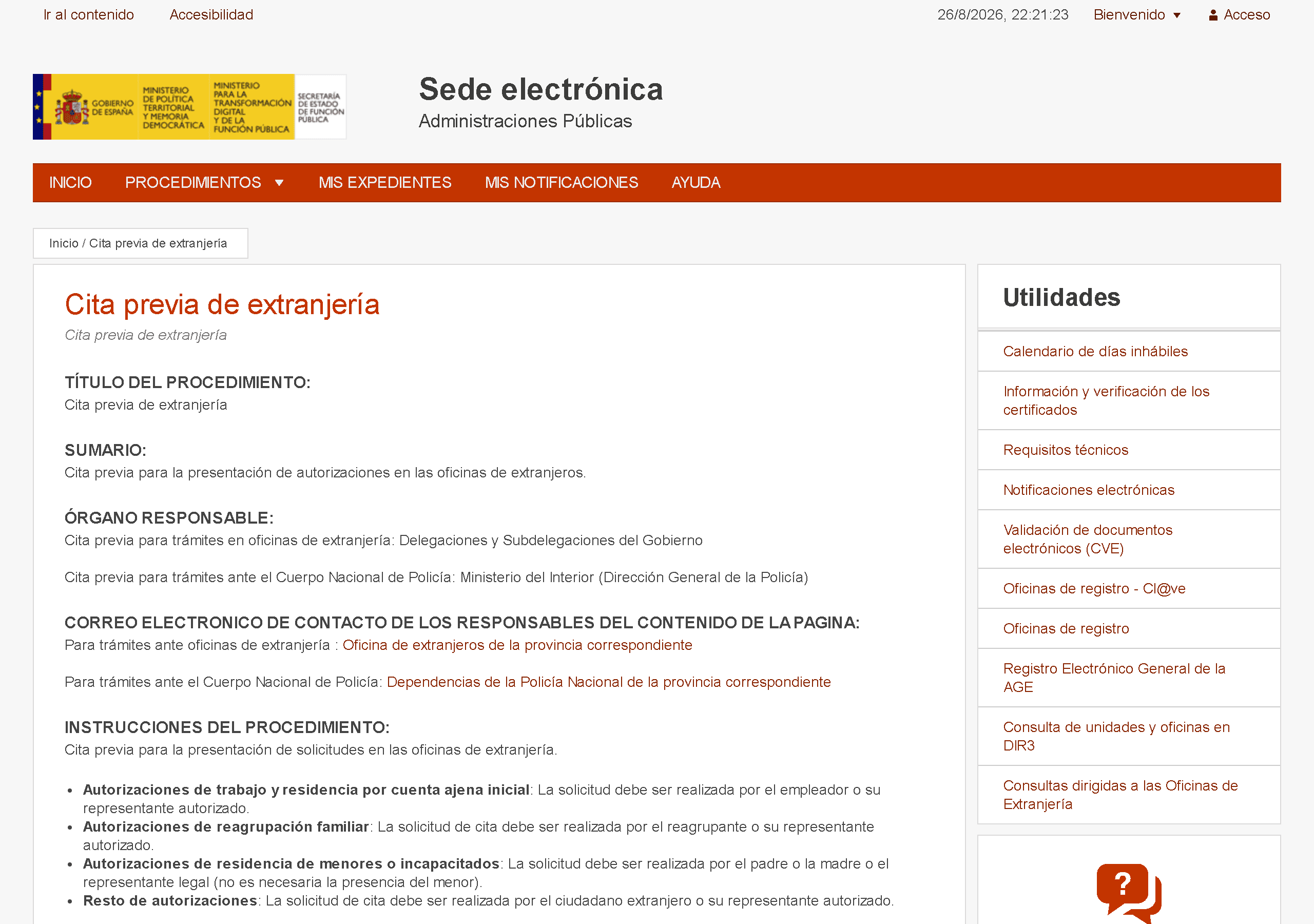
- Appointments at immigration offices are run by the Government Delegations and Sub-delegations. This is the route for authorisations — work, residence, family reunification.
- Appointments with the National Police are a separate system under the Ministry of the Interior. This is the route for identity documents: the NIE and the TIE. Two systems, two booking paths — picking the wrong one is the single most common mistake.
- Contact for immigration-office procedures goes to the immigration office of your own province, not to a national address.
- Contact for National Police procedures goes to the police premises of your province. Which building that is depends on the procedure — our province pages list them.
- Read this list before booking: for an initial work and residence permit the appointment must be requested by the employer, and for family reunification by the sponsor — not by the person who needs the permit.
Documents you need
Official TIE application form
Original, completed and signed by the foreign national. Not a photocopy.
Passport or travel document with the entry stamp
Failing that, a valid passport or travel document together with the declaration of entry made within 72 hours of arriving, or a valid cédula de inscripción.
One recent colour photograph
Passport size, on a white background.
Visa, where applicable
The visa on which you entered, if your case involved one.
Resolution granting the authorisation, in certain cases
Required for SME visas for displaced minors, cross-border worker authorisations, cases under Law 14/2013 on support for entrepreneurs, and residence or stay granted following a judicial appeal.
Proof of payment of the fee
790-012The amount depends on which card you are being issued. First grant of temporary residence is €16.08; renewal €19.30; long-term residence €21.87.
Common questions
How long do I have to apply for my TIE?
One month, applied for personally. The month runs from your entry into Spain, or from when the authorisation is granted or takes effect — not from the date of your appointment.
Does the TIE replace my passport?
No, and this is the most common misunderstanding about it. The TIE certifies your administrative situation in Spain. Your identity is proved by the document issued by your own country, so under article 13.1 of Organic Law 4/2015 you should carry both.
I entered Spain from France by road and got no stamp. What now?
You need to make a declaration of entry personally at any police station or immigration office within 72 hours of entering Spain. Without either an entry stamp or that declaration, the initial card application is missing a required document.
How much does a TIE cost?
It depends on the card. A first grant of temporary residence, stay or cross-border worker authorisation is €16.08. A renewal is €19.30. Long-term residence is €21.87. A card for a minor under the guardianship of a public body is free.
I have moved house. Do I have to tell anyone?
Yes, within one month and in person, at the police station or immigration office where you live. The same applies to a change of nationality or any change in family or other circumstances affecting the details printed on the card. If you have been formally required to report it, you have fifteen days instead.
Can my lawyer apply for me?
No. The application must be submitted personally by the foreign national. A minor is the exception: they must be accompanied by their legal representative, properly accredited with original valid identity documents, or by someone those representatives have empowered.
Which office, in your province
Not every police station handles every procedure, and the assignment differs from province to province — in Alicante the residence card is issued at one address and the NIE at another. Pick your province to see the offices that actually do this one, with addresses and phone numbers.
- A Coruña
- Álava
- Albacete
- Alicante
- Almería
- Asturias
- Ávila
- Badajoz
- Balearic Islands
- Barcelona
- Burgos
- Cáceres
- Cádiz
- Castellón
- Ceuta
- Ciudad Real
- Córdoba
- Cuenca
- Girona
- Granada
- Guadalajara
- Gipuzkoa
- Huelva
- Huesca
- Jaén
- La Rioja
- Las Palmas
- León
- Lleida
- Lugo
- Madrid
- Málaga
- Melilla
- Murcia
- Navarre
- Ourense
- Palencia
- Pontevedra
- Salamanca
- Santa Cruz de Tenerife
- Segovia
- Seville
- Soria
- Tarragona
- Teruel
- Toledo
- Valencia
- Valladolid
- Bizkaia
- Zamora
- Zaragoza
Sources
Every fact on this page comes from one of these. We do not cite other guides, because a copy gives us no way to notice when the original changes.
- Régimen General — Tarjeta de identidad de extranjeroMinisterio del Interior
- Tasas — ExtranjeríaMinisterio del Interior
- Cita previa de extranjeríaMinisterio de Política Territorial y Función Pública
This is information, not advice
Your own case depends on your nationality, your current status and your history with the administration — none of which a web page can see. Confirm anything that matters with the responsible authority or a qualified professional before you act on it.